
About this walk
The Pulpit walking track follows the rim of the Grose Valley at Blackheath, in Blue Mountains National Park, from Govetts Leap lookout north east to Pulpit Rock lookout. The whole walk is 7 km return from Govetts Leap, graded 3, and takes 2 to 3 hours. This page follows the track from Govetts Leap lookout to a point short of Pulpit Rock lookout; the track itself continues to the lookout.
What it is like
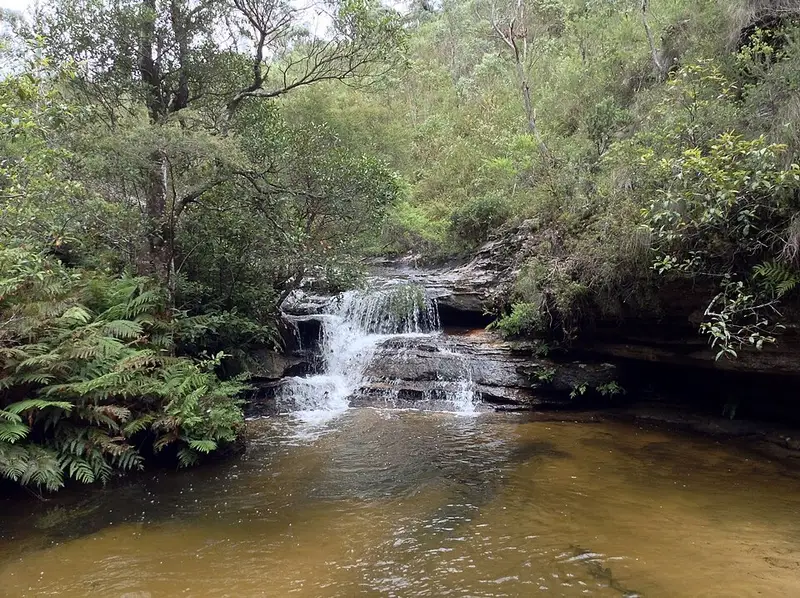
The track starts just left of Govetts Leap lookout, goes down steps into a creek lined with black wattles, crosses a bridge and follows the cliff edge to the Popes Glen Creek crossing near Horseshoe Falls. The Popes Glen track joins here, passing Boyds Beach, a small sandy beach in the glen.
From the creek, steps climb to a lookout above Horseshoe Falls. The track then follows the cliff line past a string of small lookouts, including Boyd Lookout, skirting hanging swamps and open heath, with wildflowers in November. Eucalypt forest closes in near Pulpit Rock, an isolated pinnacle standing off the cliff face. Pulpit Rock lookout is a multi tiered lookout on the outcrop with narrow, steep stairs that are slippery in the wet, and it looks across the Grose Valley to Govetts Leap and Mount Banks.
Getting there
To walk the track one way, leave a car at Pulpit Rock lookout, reached by Hat Hill Road from Blackheath. The unsealed road to the lookout can become boggy after rain.
Elevation
- Climb
- 150 m
- Descent
- 130 m
- Highest
- 1,045 m
- Lowest
- 916 m
Approximate, from a 30 m terrain model, so it can overstate the climb on cliff edge tracks.
Before you go
Tell your people where you are going
Set your route and return time in FriendsFindMe. If you do not check in, the people you trust are sent a text so they know to come looking for you.
Park and state forest boundaries: CAPAD 2024 © Commonwealth of Australia (DCCEEW), CC BY 4.0; © Forestry Corporation of NSW, CC BY 3.0 AU; © State of Queensland, CC BY 4.0; © State of Victoria (DEECA), CC BY 4.0
Walk data: © State of New South Wales (NSW National Parks and Wildlife Service), CC BY 4.0